
A US$472 billion (RM2.03 trillion) economy that expanded 5.2% in 2025, with official 2026 growth forecast at 4.0% to 5.0%.
34.4 million residents, 70.4% of them of working age, and a median age of 31.7 years.
The highest income per head of the four markets Abadi Guru covers, ahead of Thailand, Indonesia and Vietnam.
Southeast Asia's fastest-growing internet economy, up 19% year on year, with US$20 billion of it in e-commerce.
Malaysia is the smallest of the four markets we cover by headcount and the richest by a wide margin: US$13,965 of GDP per person and GNI per capita of RM57,200 in 2025, against roughly US$7,500 in Thailand, US$5,000 in Indonesia and US$4,700 in Vietnam. That is what makes it the natural first stop for a foreign product priced above the mass market: 34.4 million buyers, 70.4% of them working age, who already purchase imported brands, subscription software and overseas services.
English is the de facto language of business, ranked 24th globally on the EF English Proficiency Index with a score of 581 (high proficiency), which shortens the selling cycle that Thai and Vietnamese markets run in local language. Connectivity is effectively universal: 35.4 million internet users, 30.7 million TikTok adults, 23.6 million on YouTube and 23.0 million on Facebook, with Shopee, TikTok Shop and Lazada carrying the marketplace volume. One caveat to plan around: those penetration percentages are measured against a 36.1 million population base, roughly two million above the national statistics office estimate, so read 98.0% as 'almost everyone' rather than a precise headcount.
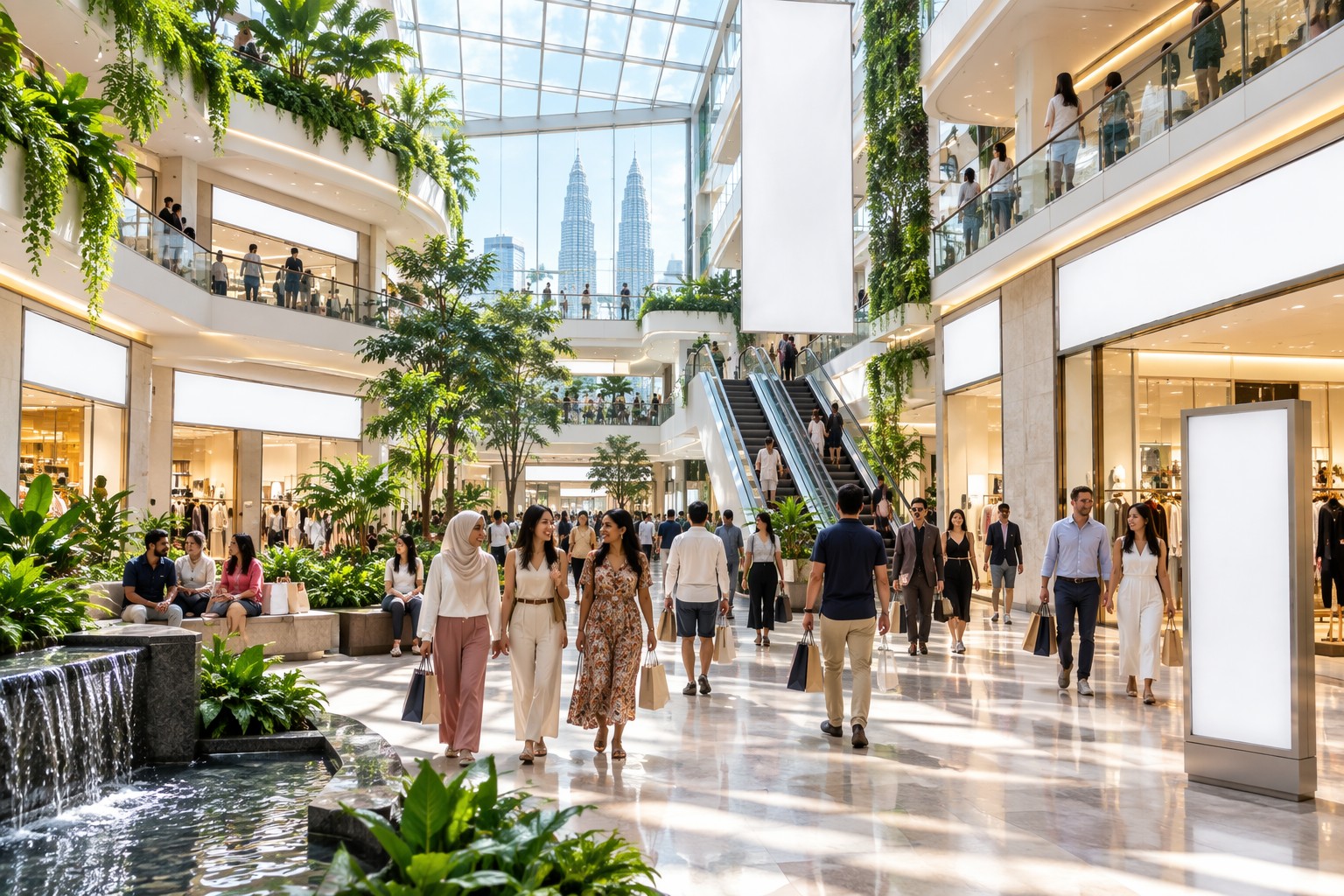
Malaysia couples a record investment pipeline with the region's most open ownership rules, and is spending to anchor semiconductors and AI compute on its own soil.
RM426.7 billion of investment was approved in 2025, up 11.0% year on year, of which RM207.1 billion was foreign direct investment (up 20.9%) across projects that create 244,902 jobs. The first half of 2026 alone booked RM218.5 billion, with foreign capital accounting for 58.1%.
Incentives run from 1 January 2025 to 31 December 2034 across nine flagship zones covering roughly 3,500 square kilometres: a 5% special tax rate on qualifying income for 10 or 15 years, and a 15% flat personal income tax for eligible knowledge workers for up to ten years. Qualifying thresholds are sector-specific, so each case is confirmed against the zone's activity list.
Foreign investors have been able to hold 100% of equity in new and expansion projects since June 2003, and the Companies Act 2016 attaches no equity condition to service-sector companies. A New Investment Framework with the National Investment Aspirations scorecard opens in Q1 2026 for manufacturing and Q2 2026 for services, with legacy applications closed after 28 February 2026.
The government has allocated RM25 billion to the National Semiconductor Strategy, with more than RM85 billion of semiconductor investments approved as at December 2025. Data-centre and cloud approvals reached RM95.8 billion in the first half of 2026, about 44% of all investment approved that half-year.
The money is going into rail that links the east coast to Port Klang, a fixed crossing into Singapore, and the compute capacity that is being built out of Johor.
A 665 km, RM50.27 billion double-tracking line owned by Malaysia Rail Link and built by China Communications Construction was 95.41% complete in August 2026, with commercial operations targeted for mid-December 2026 or January 2027.
The rail crossing between Bukit Chagar and Woodlands is substantially complete on the Malaysian side, where costs were revised up 29.9% to RM5.24 billion. Opening has moved from December 2026 to February 2027 pending testing and safety certification.
Johor's data-centre market is valued at US$39.11 billion (RM159.9 billion) with 8,542 MW of incoming capacity and 1,110 MW already live, second only to Japan in Asia-Pacific. YTL Power and JLand are developing a 1.2 GW campus at Sedenak Tech Park, and Microsoft's US$2.2 billion programme opened three centres in 2025. Johor has held off new water-cooled approvals since late 2025, so capacity growth is now conditioned on water and power agreements.
A 29.5 km, 21-station light-rail line with costs capped at RM16 billion (US$3.7 billion), owned by MRT Corp. Construction began on 11 January 2025 and was 8.99% complete by June 2026, with completion set for 2031.

Malaysia is not a low-cost assembly base: it is an electrical and electronics, semiconductor packaging, palm-oil, petroleum-refining and automotive economy that shipped a record RM1.61 trillion of exports in 2025, taking total trade to RM3.06 trillion (+6.3%) with a RM156.8 billion surplus. Penang and Kulim host the chip cluster; halal exports alone reached RM68.52 billion. The ringgit was Asia's best-performing currency in 2025, up 10.1% against the US dollar, which makes foreign goods cheaper for Malaysian buyers and signals a market that settles its bills.
With Abadi Guru running your local prospecting and closing as your appointed agent, or staffing your customer operations from Batam, foreign brands reach this industrial and consumer base without incorporating a Sdn Bhd, appointing a resident director, or taking on EPF, SOCSO and EIS obligations.
By choosing our BPO operations or appointing us as your commercial marketing agent, you test and sell into Malaysia with zero Malaysian entity registration, zero employment liability, and English-first commercial coverage.
Bahasa Malaysia is the sole official language under Article 152 of the Federal Constitution and the National Language Act 1963/67, and mass-market, packaging and government tenders are expected to comply. MyInvois e-invoicing phased in from 1 August 2024 and completes with businesses below RM5 million revenue from 2026, with the exemption threshold raised from RM1 million to RM3 million and no section-120 penalties during the relaxation to 31 December 2027. You cannot invoice Malaysian customers cleanly without local system integration.
Companies with more than 50% non-Malaysian shareholding must hold a KPDN Wholesale/Retail Trade licence with at least RM1,000,000 paid-up capital, which typically takes two to four months to process. Bumiputera participation conditions still attach to certain licences, incentives and government tenders.
Minimum wage is RM1,700 a month nationwide from 1 August 2025, rising to RM2,000 from June 2027 with an RM2,500 floor for graduates. EPF employer contributions run 13% below RM5,000 of wages and 12% above, plus a mandatory 2% employer and 2% employee contribution for foreign workers from October 2025; SOCSO is 1.75% plus 0.5% with a RM6,000 wage ceiling. Severance is 10, 15 or 20 days' pay per year of service by tenure band, with up to 24 months of back wages awarded at the Industrial Court.
Compare the bureaucratic path of Sdn Bhd incorporation, licensing and payroll registration against our agile on-the-ground operational model.
| Evaluation Metric | Traditional Malaysian Sdn Bhd + Licences | Abadi Guru Appointed Agent & BPO |
|---|---|---|
| Foreign Ownership & Equity Conditions | 100% foreign equity is permitted, but WRT-licensed trading activities and some incentives and tenders carry Bumiputera participation conditions | Not applicable - no Malaysian entity, no equity condition to satisfy |
| Minimum Capital Reality | No statutory paid-up floor (effectively RM1), but RM1,000,000 where a WRT licence applies and RM500,000 to RM1 million as convention for expatriate-pass applications | USD $0 (zero capital escrow required) |
| Time to First Invoice | SSM incorporation in 1 to 3 working days, then 2 to 4 weeks for the corporate bank account, tax, EPF and SOCSO registration - three to six months where a licence is required | 7 to 14 days plug-and-play launch |
| Resident Director & Secretary | At least one director ordinarily resident in Malaysia under the Companies Act 2016, plus a Malaysian-resident qualified company secretary and a registered office | None to appoint - we operate under contract, with no Malaysian office or resident officer to maintain |
| Tax File & E-Invoice Compliance | 24% corporate income tax (15% on the first RM150,000 and 17% on RM150,001 to RM600,000 for qualifying MSMEs), SST at 5% or 10% sales and 6% or 8% service, plus MyInvois integration | No Malaysian tax file to open or maintain; invoicing runs through our books |
| Customer Acquisition & Sales | Must recruit, train and manage unproven local reps, and carry wage, EPF, SOCSO, EIS and severance obligations as the employer | We find, prospect, negotiate, and close Malaysian customers for you |